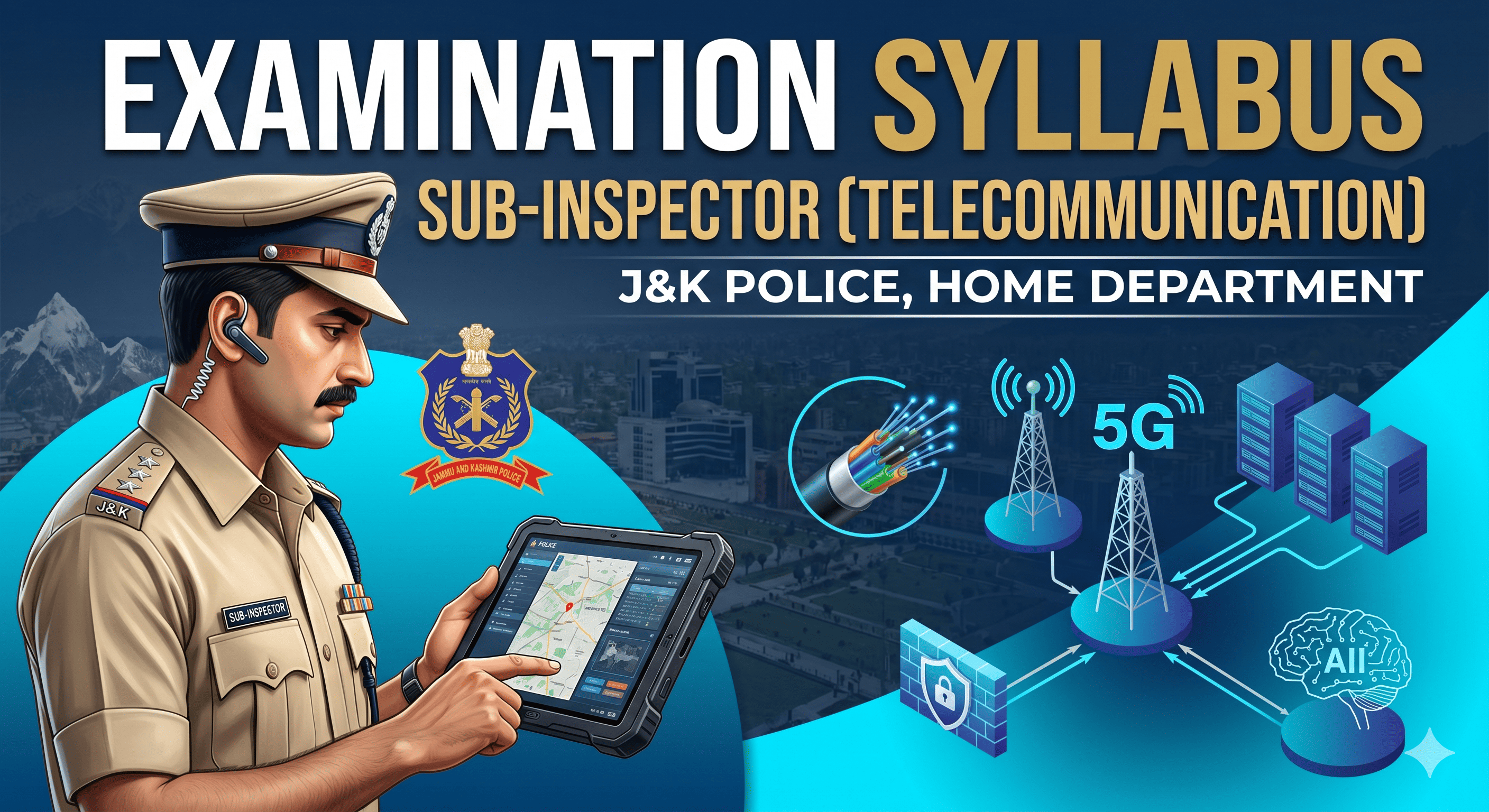
J&K POLICE (HOME DEPARTMENT)
Syllabus for Written Examination: Sub-Inspector (Telecommunication)
Format: 100 Objective Type (MCQ)Total Marks: 200 (2 per question) Negative Marking: 0.5 per wrong answer Duration: 120 Minutes
PART-A: General Awareness & Communication (60 Marks)
20 Marks
1. General Knowledge & Current Affairs
- Major national and international events
- Indian economy: budget, flagship schemes, reforms
- Developments in science & technology
- Space, defence and nuclear programmes
- Indian Polity: Preamble, Fundamental Rights & Duties, DPSP
- Disaster Management, Climatic change
10 Marks
2. GK Special Reference to J&K UT
- History of Jammu & Kashmir
- Geography: rivers, lakes, climate, soils, flora & fauna
- Jammu & Kashmir Reorganisation Act, 2019
10 Marks
3. General English & Communication
- Grammar: tenses, modals, articles, prepositions
- Active & passive voice | Direct & indirect speech
- Synonyms, antonyms, idioms and phrases
- Reading comprehension & Error spotting
- Professional communication: official drafting, email etiquette
10 Marks
4. General Intelligence & Reasoning
- Analogies, Number and letter series
- Coding-decoding & Venn diagrams
- Syllogisms & Blood relations
- Logical reasoning and pattern recognition
10 Marks
5. Basic Numeracy
- Ratio and proportion | Percentages
- Profit and loss | Simple and compound interest
- Averages | Time, speed and distance
- Elementary statistics and data interpretation
PART-B: Technical/Professional Knowledge (140 Marks)
10 Marks
6. Engineering Maths & Signals
- Linear algebra: matrices, determinants, eigenvalues
- Calculus: differentiation, integration, differential eq.
- Transforms: Fourier series, basics of Fourier and Laplace
- Signals & Systems: sampling theorem, convolution, LTI systems
- Spectra, bandwidth, aliasing, basic filters
20 Marks
7. Electronic Devices & Network Theory
- Devices: Semiconductor basics, PN/Zener diodes, BJT, MOSFET
- Analog: Op-amps (Inverting/Non-inverting), Integrators, Oscillators
- Network: KVL/KCL, Mesh/Nodal analysis, Network theorems, Resonance
20 Marks
8. Digital Electronics & Microprocessors
- Number systems, Logic gates, Boolean algebra, K-maps
- Combinational & Sequential circuits (Flip-flops, Counters)
- 8085/8086 architecture, instructions, interrupts
- 8051 microcontroller & Introduction to ARM
20 Marks
9. Communication Systems
- Analog: AM, FM, PM modulation and noise
- Digital: PCM, DPCM, DM, ASK, FSK, PSK, QPSK
- Propagation: Antennas, Ground/Sky/Space waves
- Mobile: 2G to 5G evolution, FDMA, TDMA, CDMA, OFDMA
20 Marks
10. Computer Science & Networking
- OSI and TCP/IP models, IP addressing, Subnetting
- Routing protocols (RIP, OSPF), Switching techniques
- Wireless: Wi-Fi (802.11), Bluetooth, NFC
- OOPs concepts, Data structures, OS (Process/Memory)
10 Marks
11. Cyber Security & Legal
- Threats: Malware, phishing, ransomware
- Firewalls, IDS/IPS, Authentication (SSL/TLS)
- Cryptography: Symmetric/Asymmetric, Hashing
- IT Act 2000 and post-quantum cryptography
10 Marks
12. IT Systems & e-Governance
- Web application basics, Client-server architecture
- Cloud computing fundamentals
- Data centres, backup and disaster recovery
- Govt IT systems and Interoperability
10 Marks
13. DBMS
- Architecture, Data models, Relational databases
- SQL concepts, Design and Normalization
- Integrity constraints, Transaction & Concurrency
- Storage, indexing and security
10 Marks
14. IoT & Mechatronics
- IoT architecture and M2M communication
- Surveillance: CCTV, ANPR, RFID
- Drone technology and Robotics fundamentals
- Sensors, Actuators, Hydraulics/Pneumatics
10 Marks
15. Artificial Intelligence & Data Science
- Fundamentals of AI and components
- AI in engineering and government systems
- Big data and analytics in law enforcement
- Ethical concerns and automation